Two hosts at different stages
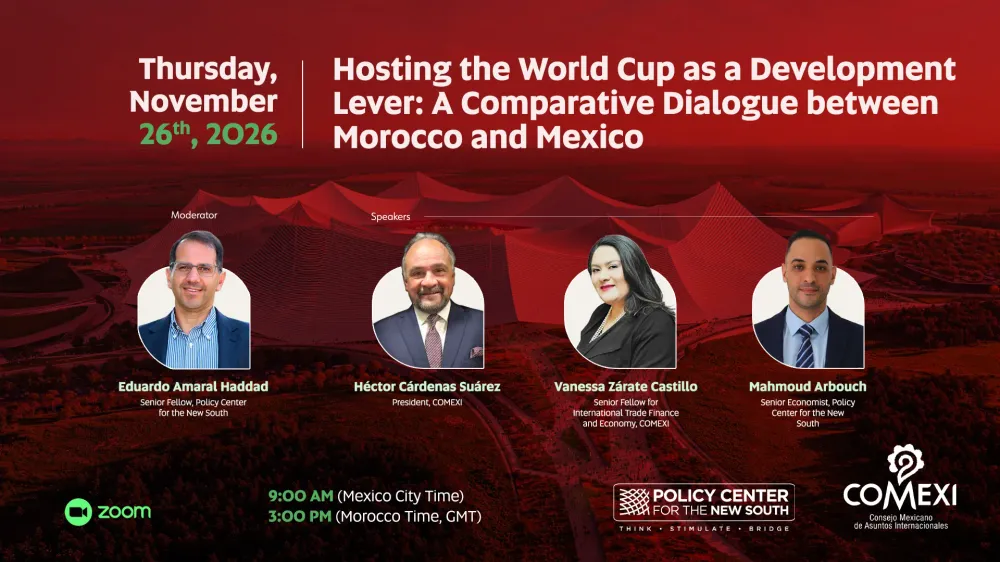
The webinar, "Hosting the World Cup as a Development Lever: A Comparative Dialogue between Morocco and Mexico," begins Thursday at 9:00 a.m. in Mexico City and 3:00 p.m. in Rabat. The organizers plan to examine infrastructure, financing and post-tournament use rather than assume that hosting will produce an economic windfall.
Mexico hosted the men's World Cup on its own in 1970 and 1986 before sharing the 2026 edition with the United States and Canada, according to S&P Global Market Intelligence. Morocco is preparing to co-host the 2030 tournament with Spain and Portugal.
The organizers see common policy challenges despite those different timelines. Both countries are emerging economies sharing hosting duties with partners of different economic weight. Each must meet international tournament requirements while addressing domestic development needs and public expectations. Mexico's experience offers lessons in stadium use, city management, security, transportation and cooperation between public authorities and businesses; Morocco's planning offers a perspective on fitting the event into a longer-term national strategy.
Morocco's investment plans and financing
Morocco's preparations extend beyond stadiums to transportation networks, airports, tourism facilities and digital connectivity. The Rio Times reports that the country has earmarked more than US$23 billion for World Cup-related projects. Reported direct football investment amounts to 50–60 billion dirhams, or about US$5.3–6.4 billion, while broader infrastructure upgrades total roughly 215–220 billion dirhams, or US$23–23.5 billion.
An IMF assessment cited by Moroccan media and reported by The Rio Times puts tournament-related connectivity and tourism infrastructure spending over 2024–2030 at 11.9% of Morocco's 2024 GDP. Its breakdown assigns 6.0% of GDP to rail, 2.4% to airports, 2.2% to stadium construction and renovation, 0.9% to roads, and 0.5% to urban and tourism infrastructure.
The same assessment expects state-owned enterprises to provide the largest share of financing, equivalent to 7.4% of GDP. Subnational governments would finance 3.2% of GDP through bank borrowing, with another 1.4% of GDP coming from the central government budget.
The IMF estimates that the program will increase the fiscal deficit by an average of about 1.2% of GDP annually during 2024–2030 and add 7–8% of GDP to public debt by 2030. Its simulations also suggest potential gains: real GDP could be about 2% higher by 2030 than under a no-investment scenario, rising to around 3% higher after 2031.
Tourism expansion is another part of the preparations. According to The Rio Times, Morocco received nearly 20 million tourists in 2025, the highest total in Africa. It is targeting 26 million visitors annually by 2030, while hotel capacity is being increased by about a fifth ahead of the tournament.
Mexico's experience and the limits of projected gains
The 2026 World Cup is the largest edition in the tournament's history, with 48 teams and 104 matches spread across 16 cities in the United States, Canada and Mexico, according to Bangkok Bank's BBL Research. The research cited expectations of more than 6.5 million attendees and an OpenEconomics estimate that the event could generate about US$40.9 billion in global GDP and support around 824,000 jobs.
Mexico's share comprised 13 matches in Mexico City, Guadalajara and Monterrey. S&P Global Market Intelligence projected a contribution of just 0.1–0.2 percentage points to the country's real GDP growth. Its analysis cited official expectations of around 5 million international visitors during the tournament and estimated additional tourism revenue of approximately US$2.3 billion, equivalent to about 0.1% of GDP.
Previous tournaments illustrate the gap that can emerge between forecasts and returns. BBL Research cites economists Robert Baade and Victor Mathon's estimate that the economic impact of the 1994 World Cup in the United States was US$5.5–9.3 billion below original forecasts. It also cites research by Oxford University's Bent Flyvbjerg finding average cost overruns of around 172% for major sporting events.
BBL Research reports that Brazil spent more than US$11 billion to host the 2014 World Cup but saw relatively limited post-event returns. For Qatar's 2022 tournament, it cites an IMF estimate of an economic boost equivalent to only 0.7–1.0% of GDP.
The webinar organizers point to research suggesting that infrastructure that improves connectivity offers stronger long-term returns than facilities built specifically for an event. They emphasize that the mix of projects, financing terms, external balances and use after the tournament will shape Morocco's eventual returns. The comparison with Mexico is intended to help identify shared risks and policy trade-offs, not simply compare tournament spending.
Speakers and schedule
PCNS Senior Fellow Eduardo Amaral Haddad will moderate the webinar, beginning with a welcome and introductions from 3:00 to 3:05 p.m. Rabat time.
Opening remarks from 3:05 to 3:15 p.m. will feature COMEXI President Héctor Cárdenas Suárez; Vanessa Zárate Castillo, COMEXI's Senior Fellow for International Trade Finance and Economy; and Mahmoud Arbouch, Senior Economist at PCNS.
The moderated discussion is scheduled for 3:15 to 4:25 p.m., followed by closing remarks ending at 4:30 p.m.